Streamlining Enterprise Secret Management: How Vault Secrets Operator (VSO) Elevates Kubernetes Security
The Secret Management Challenge in Kubernetes
Platform teams tasked with managing Kubernetes environments at scale often encounter a critical security gap. As clusters expand across clouds and on-premises infrastructure, the initial question—"How do I get a secret into my pod?"—quickly evolves into a more complex one: "How do I manage the entire lifecycle of that secret, from generation and injection to rotation and revocation, without slowing down development?" Native Kubernetes Secrets, while sufficient for basic use, fall short of enterprise governance requirements. They lack robust lifecycle automation, fine-grained access control, and the ability to manage secrets outside Kubernetes, forcing teams to seek more comprehensive solutions.
Why a Centralized Solution? The Role of Vault
Managing sensitive data and identity-based access across hybrid clouds has become a top priority. A centralized, platform-agnostic secret management solution is essential for enterprises. HashiCorp Vault has emerged as the widely adopted standard, offering consistent secret storage, dynamic secrets, auditing, and policy enforcement. For Kubernetes and Red Hat OpenShift environments, Vault provides a secure backbone, but integration patterns vary significantly in terms of operational overhead, security posture, and developer experience.
Integration Patterns Overview
Multiple Vault integration patterns exist, each with distinct tradeoffs. Historically, platform teams defaulted to the Vault Agent Sidecar Injector, as it was one of the first robust solutions. However, as the partnership between HashiCorp and Red Hat deepened through IBM, a more modern, Kubernetes-native approach was introduced: the Vault Secrets Operator (VSO). Today, the decision matrix includes VSO, VSO Protected Secrets (with a built-in CSI companion driver), the Secrets Store CSI Driver (SSCSI), Vault Agent Sidecar Injector, and various third-party secrets operators. Understanding which to use can be overwhelming, but VSO has become the recommended standard for most use cases.
Comparing Vault Integration Methods
Vault Agent Sidecar Injector (Legacy)
This pattern injects a Vault Agent sidecar container into each pod. The sidecar fetches secrets from Vault and writes them to a shared volume or environment variables at startup. While powerful, it introduces additional resource overhead, requires careful configuration for lifecycle events (e.g., rotation), and can complicate debugging. It also means changing how pods interact with secrets—often requiring application code updates.
Secrets Store CSI Driver (SSCSI)
The Secrets Store CSI Driver (SSCSI) mounts secrets as volumes using the Container Storage Interface (CSI). It works with Vault (and other providers) and allows fine-grained secret rotation without pod restarts. However, it requires running a CSI driver on each node, adds complexity in multi-cloud setups, and still needs external synchronization for lifecycle automation beyond mounting.
Third-Party Secrets Operators
Operators like External Secrets Operator or Kubernetes External Secrets provide custom resources to sync secrets from Vault into Kubernetes Secrets. They offer flexibility but often lack deep integration with Vault’s features (e.g., dynamic secrets, leasing). They also introduce another operational layer and may not align with Vault’s recommended security practices.
Vault Secrets Operator (VSO) – The Modern Approach
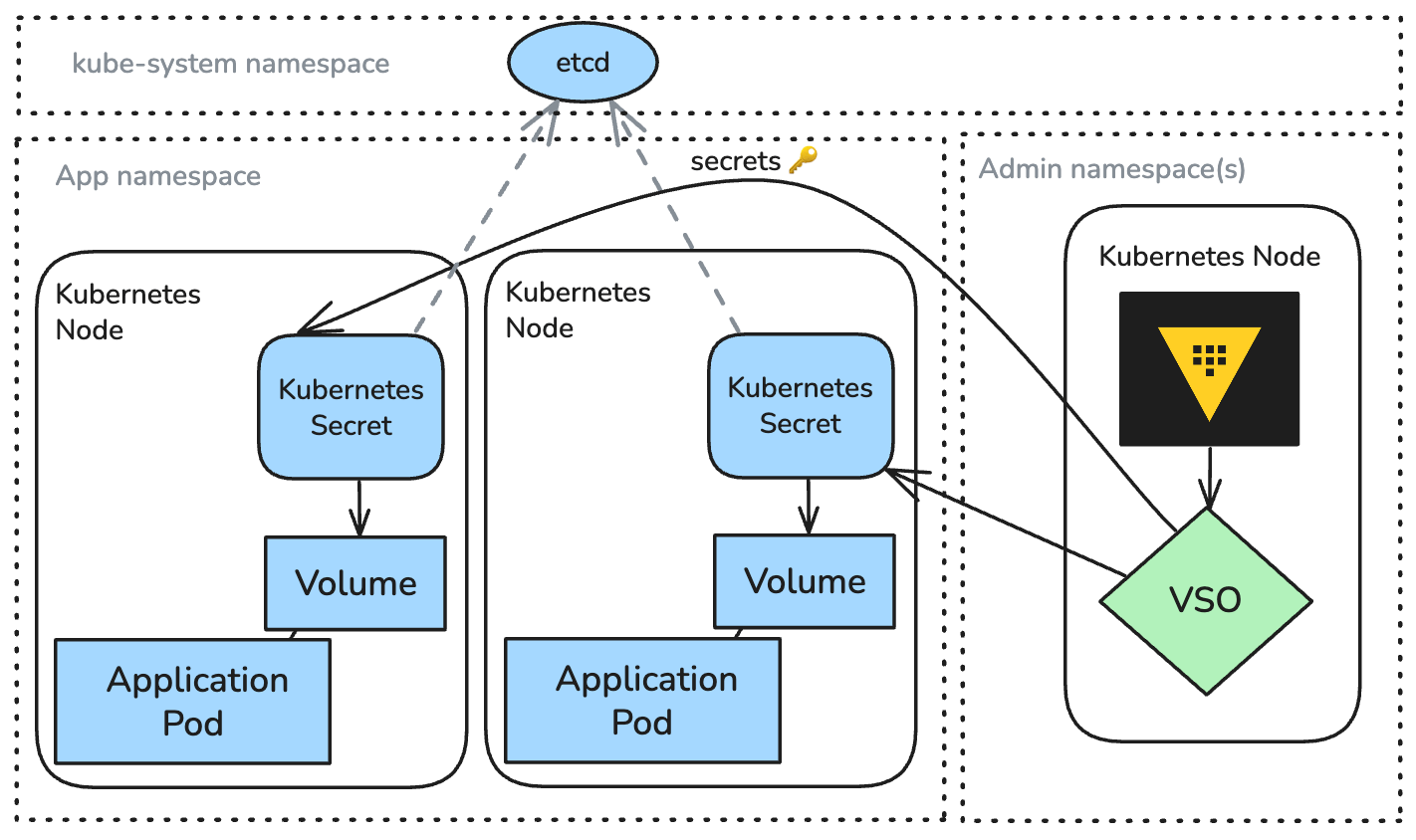
The Vault Secrets Operator (VSO) is a Kubernetes-native operator that manages the lifecycle of secrets declaratively. It defines custom resources (e.g., VaultSecret) that map to Vault paths and automatically syncs secret data into Kubernetes Secrets. VSO handles rotation, revocation, and policy enforcement without requiring agent sidecars or CSI drivers. It integrates seamlessly with existing workflows—pods continue to use standard Kubernetes Secrets, eliminating the need for code changes. VSO also supports advanced features like template rendering and dynamic secrets.
VSO Protected Secrets (with CSI Companion)
For environments requiring even stronger isolation, VSO can be combined with a built-in CSI companion driver. This pattern ensures secrets are never written to etcd (the Kubernetes store) but are instead mounted directly from Vault into pods via CSI volumes. It provides the same declarative operator model while meeting the strictest compliance requirements. This hybrid approach offers both simplicity and security.
Why VSO is the Recommended Standard
The Vault Secrets Operator (VSO) addresses the core needs of platform teams: it automates the entire secret lifecycle, reduces operational complexity, and enhances security without hindering developer velocity. Key benefits include:
- Kubernetes-native: Uses standard custom resources and controllers, fitting naturally into GitOps workflows.
- No sidecar overhead: Eliminates the need for injection agents, saving resources and simplifying debugging.
- Lifecycle automation: Handles rotation and revocation automatically, aligned with Vault policies.
- Minimal developer impact: Pods consume secrets exactly as before—via Kubernetes Secrets or CSI mounts.
- Hybrid ready: Works across OpenShift and upstream Kubernetes, with consistent behavior.
- Partnership-backed: Developed in close collaboration with Red Hat, ensuring enterprise-grade stability and support.
For most organizations, VSO offers the best balance of security, simplicity, and scalability. It is the logical successor to older integration patterns and is actively recommended by both HashiCorp and Red Hat.
Conclusion
As Kubernetes adoption accelerates, enterprises must move beyond native Secrets and adopt a centralized, automated approach to secret management. The Vault Secrets Operator (VSO) represents the state of the art, providing a secure, efficient, and developer-friendly method for delivering secrets to workloads. Whether you are starting fresh or migrating from sidecar-based setups, VSO simplifies operations while strengthening your security posture. Embrace the operator-driven future for secret management and let your teams focus on building, not plumbing.